Knowledge Share
How to prepare for your first karate course or seminar
Who this guide is for
This checklist is for a beginner, parent or returning karateka who has booked—or is considering—a course, seminar or special training day. A course can be faster-paced and more crowded than a normal class, so the best preparation is to understand the organiser’s format before you arrive.
Quick answer: confirm access, pack simply and arrive ready to listen
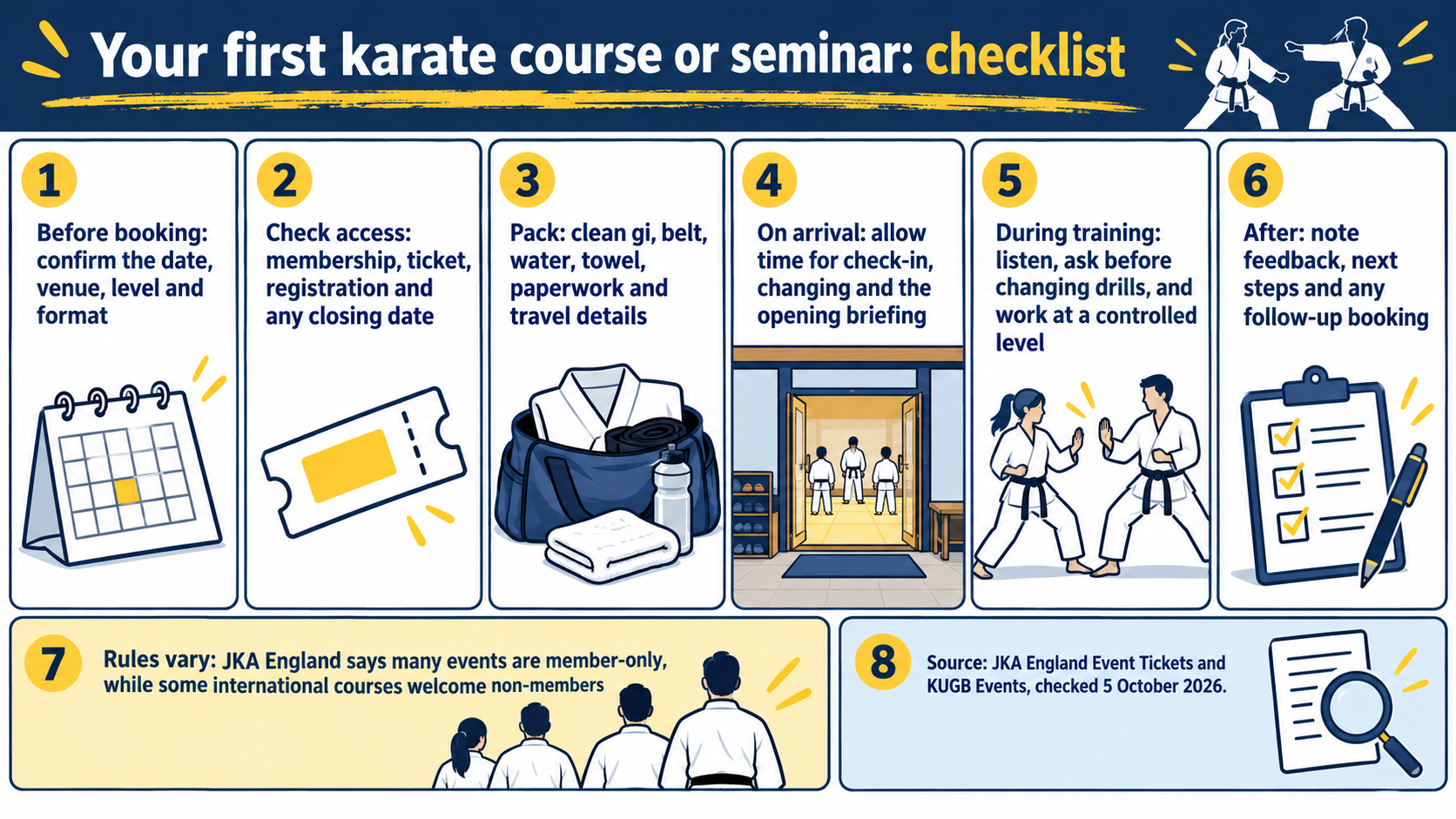
Before booking, check the date, venue, level, timetable, membership requirement and registration process. Bring a clean gi, belt, water, towel and any paperwork the organiser requests. On the day, allow time for check-in and follow the instructor’s pace; the goal is to learn safely, not to prove that you can match the most experienced person in the room.
1. Read the booking information
Do not assume that every course accepts walk-ins or non-members. JKA England says many of its events are member-only, while it identifies some international courses as open to non-members. Its ticket guidance also says that limited-space events must be booked in advance. Read the specific event notice rather than relying on a club’s older social-media post. JKA England ticket guidance
2. Check the level and timetable
Courses may be split by grade, age, discipline or role. A beginner-friendly seminar may have an all-level section, while a referee, instructor or squad session can require a minimum grade or membership. KUGB’s events listing, for example, distinguishes courses for particular members from wider training sessions and publishes separate times for training and grading. Treat the stated audience as part of the booking information, not as a suggestion. KUGB events listing
3. Pack the basics
- A clean gi, belt and spare T-shirt if the day is long.
- Water, a towel and any permitted snacks for breaks.
- Membership card, licence, ticket confirmation or grading paperwork if requested.
- The venue address, travel plan and a contact number for your instructor or organiser.
4. On the day: learn at the right pace
Arrive early enough to find the entrance, change and hear the opening briefing. Introduce yourself to the instructor or course desk and say what grade you hold. During drills, listen for the explanation before copying a faster partner. Ask before changing the exercise, keep contact controlled and take the break offered by the organiser. A seminar is a chance to collect useful details to practise later, not a test of endurance.
5. After the course
Write down one or two corrections while they are fresh, then ask your instructor how to build them into normal classes. Keep the event page or booking email until any follow-up information has arrived. If the course included a grading, selection, qualification or future booking, check the organiser’s results and registration process rather than assuming that attendance itself grants a new status.
When to check the organiser or instructor
Ask directly if the venue, membership status, ticket, fee, age or grade band, equipment, accessibility arrangement or cancellation policy is unclear. This guide does not replace the organiser’s current notice and does not give medical advice. If a physical restriction affects training, tell the instructor before the session so they can explain suitable options; do not push through pain to keep up with the group.
Sources
JKA England Event Tickets and FAQs · KUGB Events
Last checked: 5 October 2026.