Knowledge Share
Understanding karate grades: kyu and dan explained

This style-neutral guide is for parents, beginners and recreational karateka who want to understand the words kyu and dan. It explains the common framework, but it is not a universal syllabus: belt colours, grade numbers, waiting periods and assessment rules vary by style, organisation and club.
Quick answer
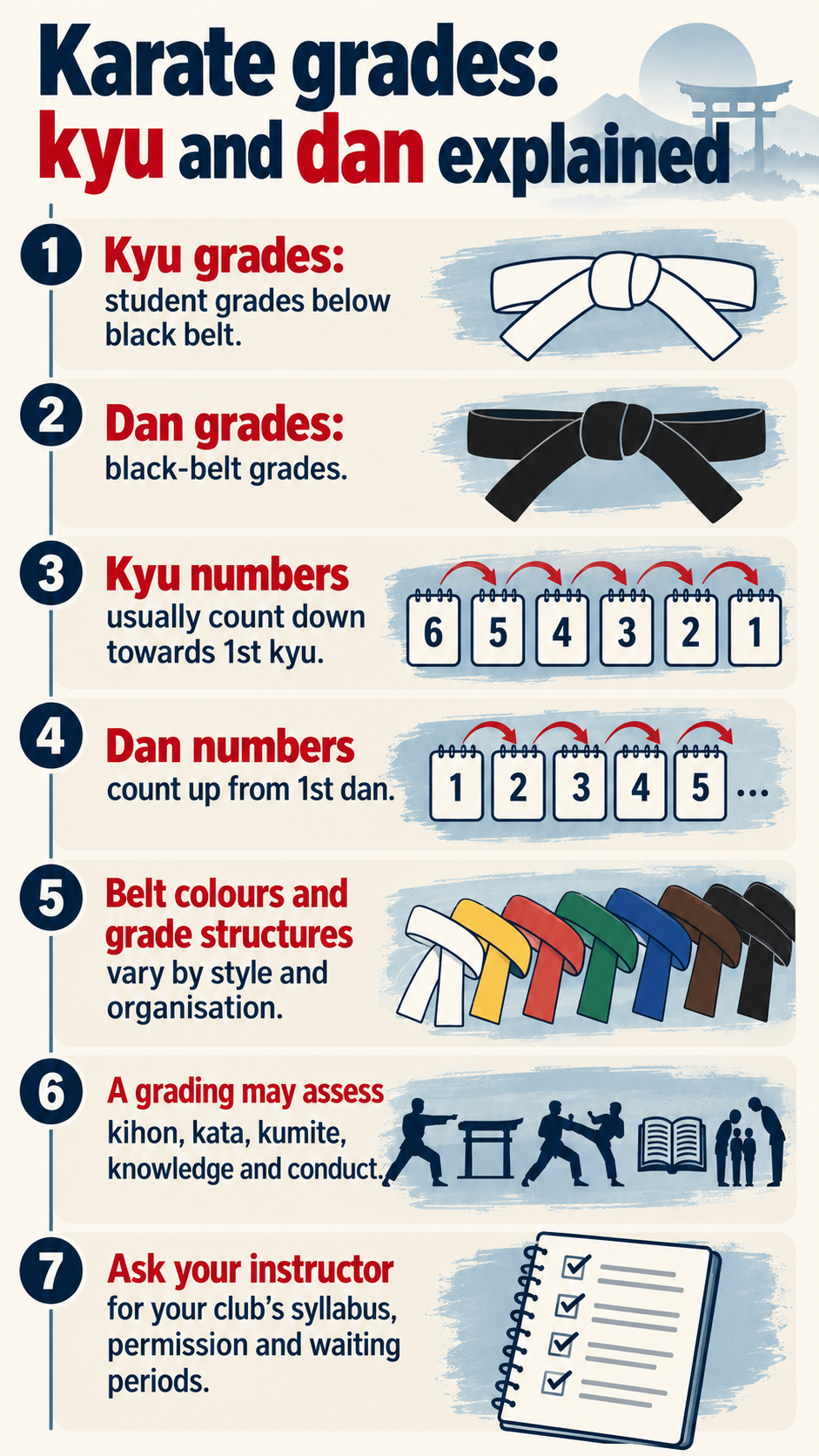
Kyu grades are generally student grades below black belt. Dan grades are black-belt grades. Kyu numbers usually count down towards 1st kyu, while dan numbers count up from 1st dan. Your instructor’s syllabus is the authority for your training.
What “kyu” means
Kyu describes the student-grade part of a karate journey. Clubs often use coloured belts to mark progress, but there is no single UK-wide colour order. For example, the KUGB describes nine grades below black belt within its own system. Treat that as an organisation-specific example, not a rule for every dojo.
What “dan” means
Dan describes black-belt grades, beginning at 1st dan and continuing upwards. Eligibility, examinations, minimum experience and progression are set by the relevant organisation. A dan grade is not simply a colour change, and requirements can become more demanding as technical understanding and responsibility develop.
Why belts and waiting periods differ
Karate styles, national bodies, associations and independent clubs can use different syllabuses. Published UK examples show variation in belt structures and grading intervals. Ask your club which syllabus applies before comparing your grade with someone from another organisation or planning a grading date.
What a grading may cover
Depending on the organisation, a grading may assess kihon (basics), kata, kumite, knowledge, etiquette, conduct, fitness or attendance. The balance and pass requirements are not universal, so use your club’s current syllabus and instructor guidance.
Beginner checklist
- Ask your instructor for the current syllabus and the grade you are working towards.
- Learn the required terminology, techniques and etiquette rather than memorising a belt colour alone.
- Check whether your club uses a licence, record book or other grading record.
- Ask about permission, attendance expectations and any waiting period before booking a grading.
- Wear a clean, secure gi and use only the protective equipment your instructor or event requires.
- Practise progressively and tell your instructor about pain, injury or any health concern before training.
When to check with your instructor
Ask before entering a grading, transferring between clubs, attending a seminar or comparing a grade from another association. Your instructor can explain how prior experience is recognised and which rules apply to the next assessment.
Sources
KUGB About Us — https://kugb.org/about-us/
UK Karate grading chart — https://www.ukkarate.co.uk/about.php
British Combat Karate Association information pack — https://www.britishcombatkarate.co.uk/downloads/BCKA-SInfoPackRev20.pdf
Last checked: 17 October 2026. Your club or organisation’s current syllabus and safety guidance take priority.