Knowledge Share
How to prepare for a karate grading: an adult beginner checklist
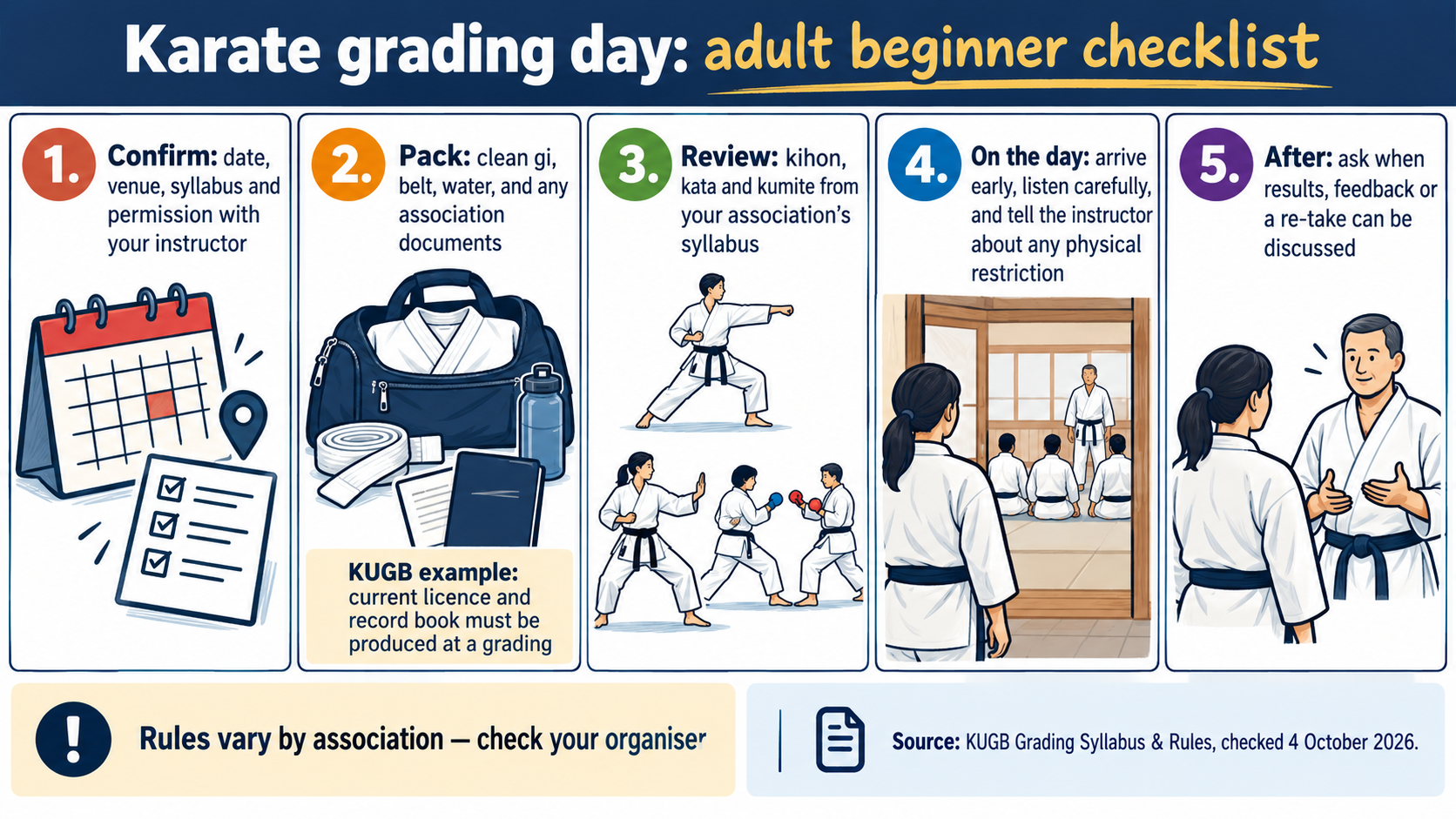
Who this checklist is for
This guide is for adult and older teenage beginners who have been told that a grading is coming up. It is a preparation checklist, not a universal syllabus. Karate associations set their own grades, documents, equipment and booking rules, so your instructor or organiser’s current instructions take priority.
Quick answer: confirm the essentials first
Before you add extra training, confirm five things with your instructor: the grading date and venue, the grade you are attempting, the syllabus or techniques to review, whether you have permission to grade, and what you must bring. In the KUGB’s published rules, permission, technical requirements, a current licence and a record book are part of eligibility; those are KUGB requirements, not a UK-wide rule. KUGB grading guidance
One to two weeks before
Use normal classes to tidy up the basics rather than trying to cram unfamiliar material. Ask your instructor to watch the kihon, kata and kumite sections expected at your grade, then make a short list of corrections. The KUGB says an examiner may ask for some or all of the listed material and may revisit work from earlier gradings, which is a useful reminder to practise foundations as well as the newest techniques.
- Write down the techniques, kata and kumite format your association expects.
- Practise slowly enough to keep posture, breathing and control consistent.
- Ask early about accessibility or physical restrictions so the organiser can advise you.
What to pack
Pack the items you have been asked to bring, not every piece of equipment you own. A clean gi, belt, water and a small towel are sensible starting points. If your association issues a licence, passport or record book, check whether it must be shown at registration. For example, the KUGB says its current licence and record book must be produced for inspection and signature at a grading.
- Gi and belt, clean and ready to wear.
- Water and any permitted personal items.
- Association licence, record book or grading paperwork if required.
On the grading day
Aim to arrive with enough time to find the hall, change and listen to registration instructions without rushing. Keep your warm-up familiar and moderate; a grading is not the moment to test a new conditioning routine. During the examination, listen for the examiner’s format, show control and recover calmly if you make a mistake. Your instructor can explain etiquette and bowing conventions for your association.
After the grading
Ask when results or feedback will be given and how the next training step will be explained. A pass, a temporary grade or a request to try again can have different meanings in different organisations. The KUGB, for example, describes temporary kyu grades and a three-month wait before a failed kyu grading can be retaken; do not assume those timings apply to your association.
When to check the organiser or instructor
Check directly if the venue, start time, fee, paperwork, grading syllabus, equipment, accessibility arrangements or result process is unclear. This guide does not diagnose injuries or prescribe treatment. If pain, illness or a physical restriction affects training, pause and seek appropriate professional or instructor guidance rather than pushing through an examination. The organiser’s current instructions always override this general checklist.
Sources
KUGB Grading Syllabus & Rules · JKA England event-ticket guidance
Last checked: 4 October 2026.