Knowledge Share
Three karate stances beginners often meet: a style-neutral guide
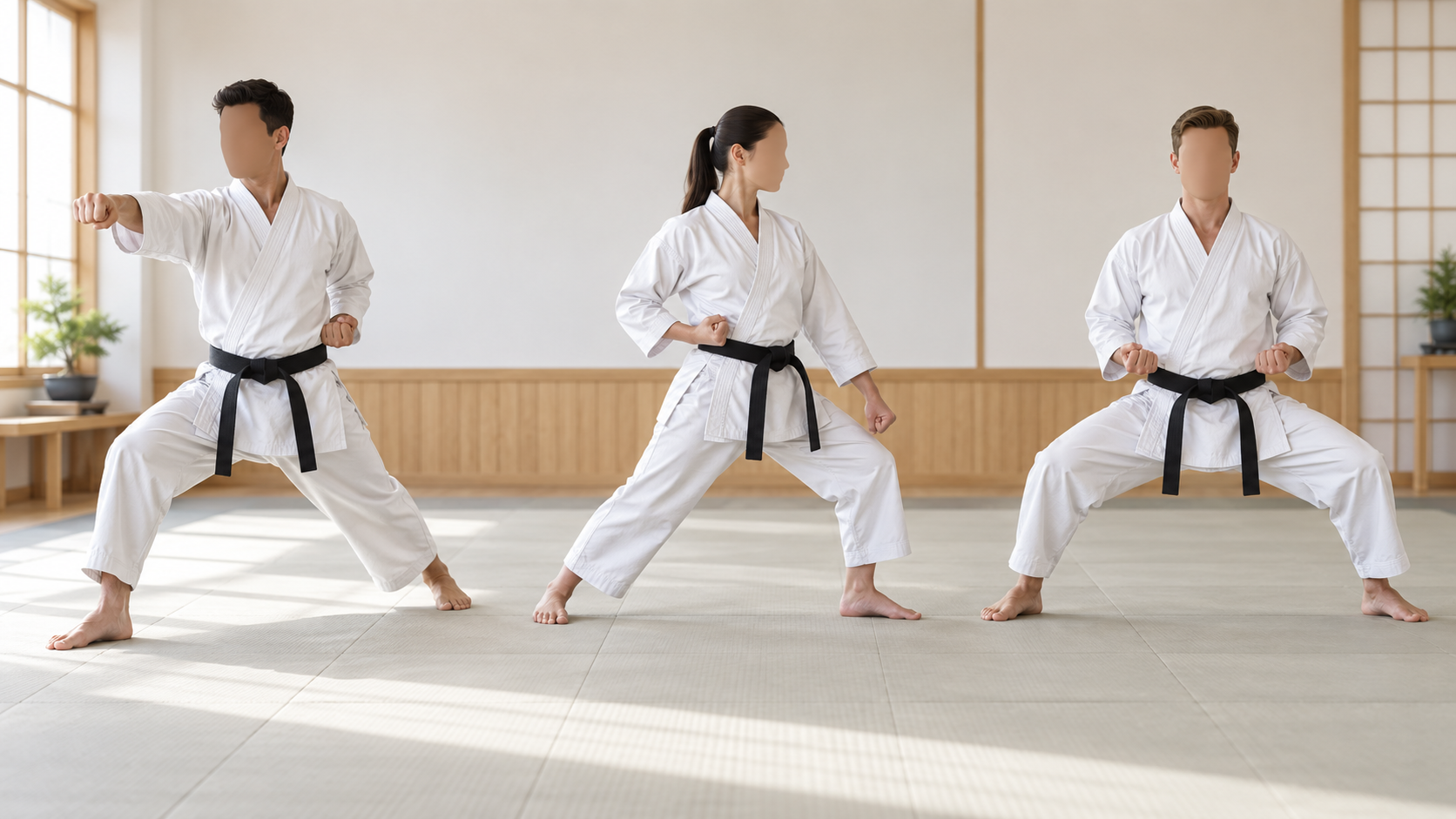
This guide is for adults, parents and young beginners who are learning the names of common karate stances. It is a style-neutral introduction, not a grading syllabus: your instructor may teach a different version or use a different name.
Quick answer
Three terms many beginners encounter are zenkutsu-dachi (front stance), kokutsu-dachi (back stance) and kiba-dachi (straddle-leg or horse-riding stance). The names are common, but exact shape, depth and weight distribution can vary between styles and organisations.
Zenkutsu-dachi: front stance
Zenkutsu-dachi is commonly translated as front stance. Beginners may meet it in basic stepping and blocking drills. Focus on a stable base and comfortable knee position rather than forcing a very long or deep stance.
Kokutsu-dachi: back stance
Kokutsu-dachi is commonly translated as back stance. Ask your instructor how your style positions the hips, feet and weight; details are not identical across every school.
Kiba-dachi: straddle-leg stance
Kiba-dachi is commonly described as a straddle-leg or horse-riding stance. Work gradually and keep the knees tracking comfortably with the feet.
A simple practice checklist
- Ask your instructor to demonstrate the version used by your club.
- Set your feet carefully before adding a block, punch or turn.
- Keep breathing relaxed and avoid locking the knees.
- Practise a short hold, then step out and reset rather than chasing depth.
- Stop and ask for help if you feel sharp pain, joint pressure or loss of balance.
Why versions differ
UK karate includes multiple styles and organisations. The British Combat Karate terminology guide lists the three terms with common English descriptions, while the JKA technical manual gives style-specific technical detail. Neither should be treated as a universal rule for every dojo.
When to check with your instructor
Check before using a stance as a grading requirement, adapting it around an injury or copying a video from another style. Your instructor can adjust stance width, knee position, posture and weight distribution for your body and your club’s syllabus.
Sources
British Combat Karate — https://www.britishcombatkarate.co.uk/karate/548/Terminology
Japan Karate Association — https://jka.or.jp/wp/wp-content/uploads/2017/04/tech_manual_instructor.pdf
Last checked: 5 October 2026. Terms and technical details can vary; follow your instructor’s current guidance.