Five safeguarding questions parents can ask a child’s karate club
12 September 2026

Quick answer
Ask the club who is responsible for safeguarding, where its policy is, how concerns are handled, and what checks and training apply to adults working with children. A well-run provider should be able to explain its arrangements clearly. This is a conversation starter, not a formal audit or a guarantee of safety.
Five useful questions
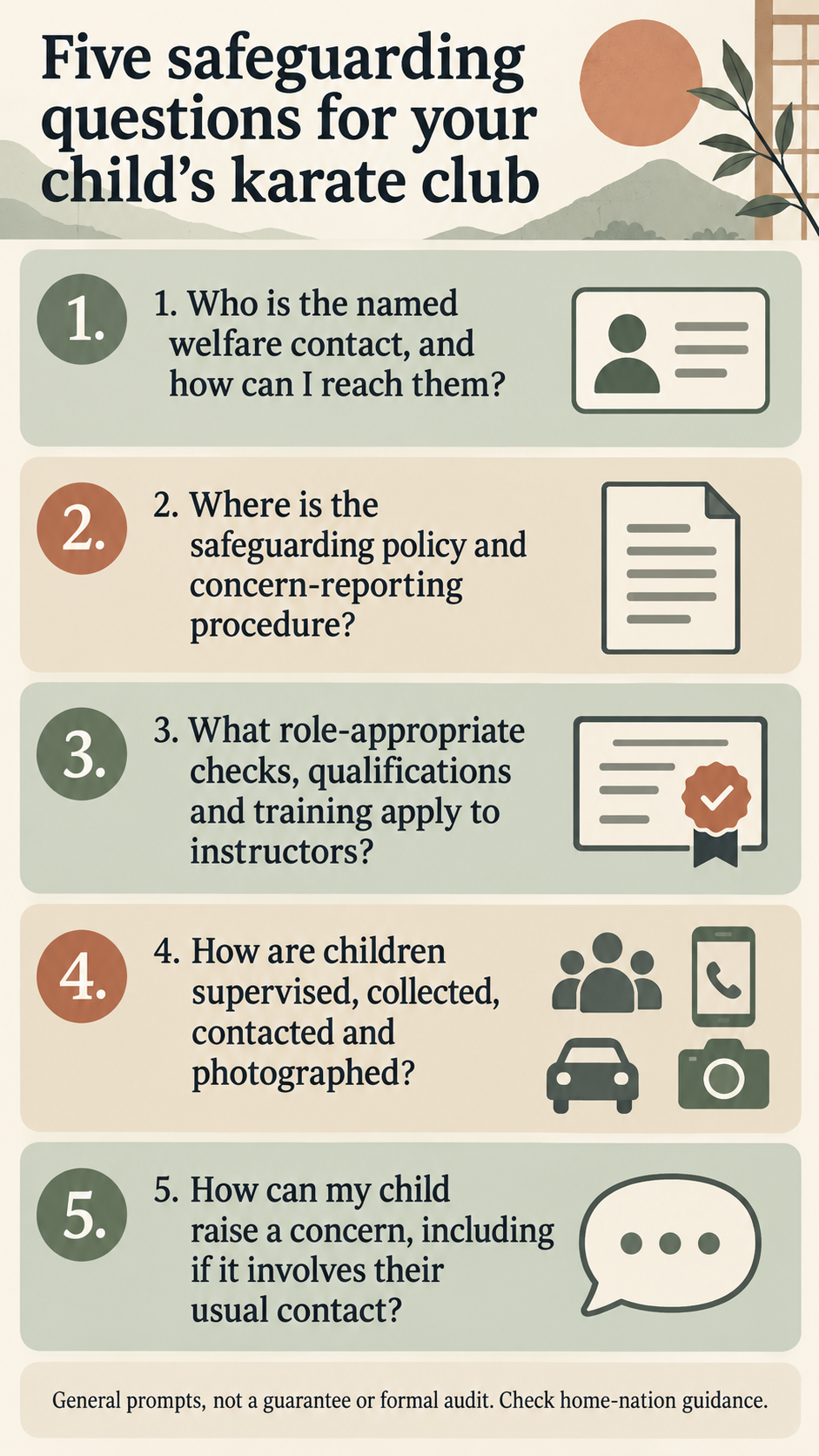
### 1. Who is the named welfare contact?
Ask for the welfare officer’s name and a way to contact them outside class. Find out who to speak to at a competition or if the usual contact is unavailable.
### 2. Where can I read the safeguarding policy?
Ask how the club records and responds to concerns, including what parents and children should do if something does not feel right. Sport England says providers should have a safeguarding policy with a clear process for dealing with concerns or risks of abuse.
### 3. What checks, qualifications and training apply to instructors?
Ask how the club verifies instructor qualifications, governing-body registration where relevant, role-appropriate DBS checks and safeguarding training. The checks required depend on the role and the organisation; a DBS check alone is not proof that a club is safe.
### 4. How are children supervised?
Ask how the club handles arrival and collection, changing areas, one-to-one situations, communication with young members, photography and trips. The exact arrangements may differ by venue and activity, but the club should be able to describe its boundaries and supervision plan.
### 5. How can my child raise a concern?
Check whether children know which trusted adult to approach and whether there is another route if the concern involves that person. Ask how the club will keep parents informed while respecting the child’s privacy and the organisation’s procedures.
What to look for in the conversation
Notice whether answers are clear, consistent and easy to find in writing. Sport England’s parent guidance also recommends checking relevant accreditation where available, insurance, qualifications and safeguarding training. Accreditation can be useful evidence of assessed practice, but it does not replace asking how the club operates day to day.
Make space for your child to talk about their experience. The CPSU encourages parents to listen, support positive enjoyment and let children know they can share both good and difficult experiences.
If you have a concern
Follow the club’s safeguarding procedure and contact its welfare lead or the relevant governing body. If a child is in immediate danger, contact emergency services. For non-immediate concerns, use the appropriate local safeguarding or child-protection route. Procedures and governing bodies differ across England, Scotland, Wales and Northern Ireland; use the organisation and local authority guidance relevant to where the club operates.
Parent checklist
- I know the named welfare contact and how to reach them.
- I can access the policy and understand how to report a concern.
- The club can explain role-appropriate checks, qualifications and training.
- Supervision, collection, communication and photography arrangements are clear.
- My child knows a trusted adult and feels able to speak up.
Limitations
This guide summarises general parent questions, not legal advice or a substitute for an organisation’s safeguarding policy. Sport England’s guidance is for England; check the relevant home-nation governing body and local safeguarding arrangements elsewhere in the UK.
Sources
- Sport England: advice for parents and carers
- Sport England: safeguarding guidance
- CPSU: parents’ role in supporting children in sport
Last checked: 12 September 2026.